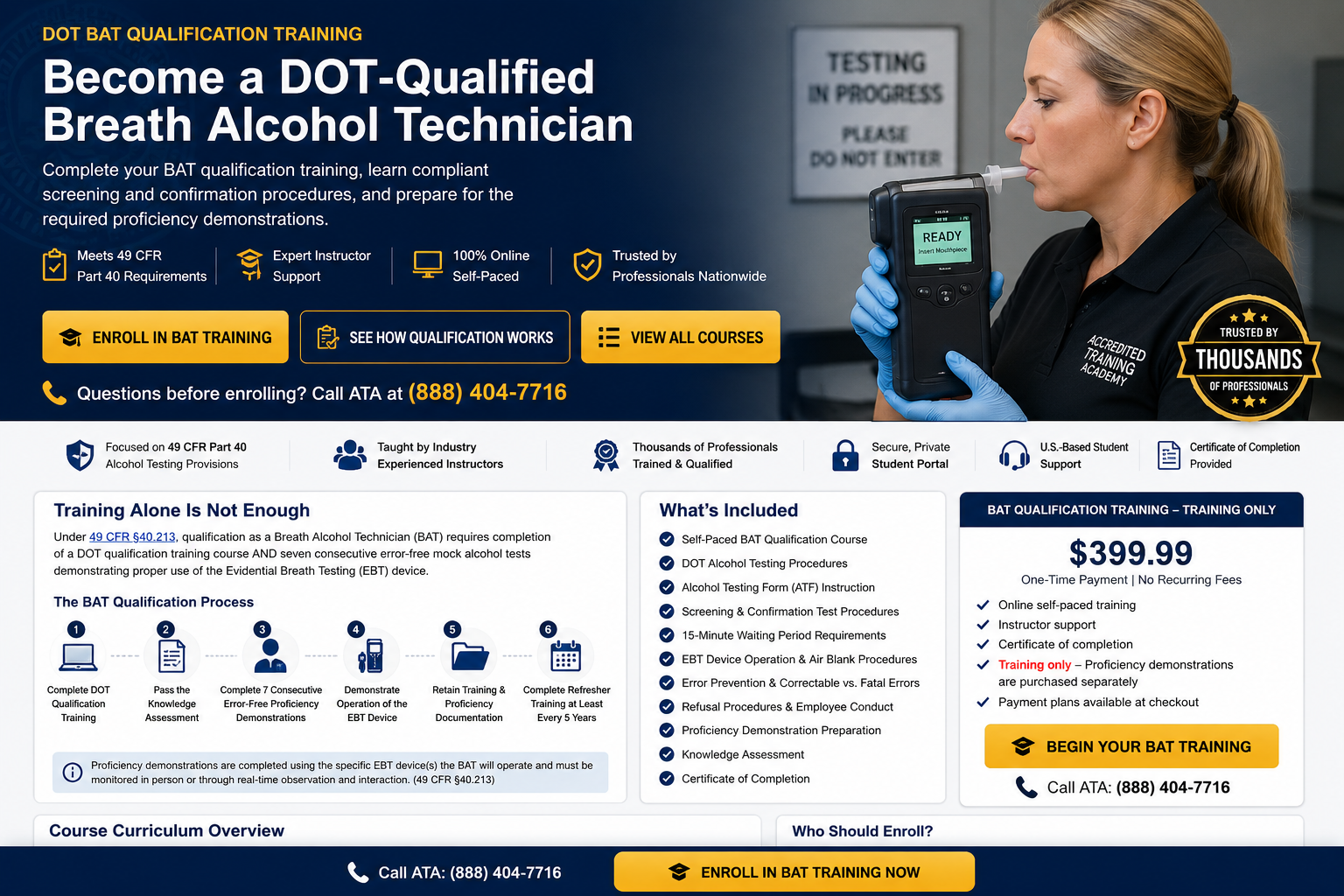
Become a DOT-Trained Breath Alcohol Technician
Learn DOT alcohol testing procedures, Alcohol Testing Form completion, screening and confirmation testing, EBT operation, privacy, test integrity, and error prevention through Accredited Training Academy.
- Built around 49 CFR Part 40
- Self-paced online instruction
- Screening and confirmation procedures
- ATF and EBT-focused training
Understand the complete BAT pathway
Training Alone Is Not Enough
To act as a BAT in the DOT alcohol testing program, an individual must complete qualification training and then demonstrate proficiency by completing seven consecutive error-free mock tests using the alcohol testing device or devices the BAT will use.
Learn the Federal Procedure
Study Part 40 alcohol testing requirements, the DOT Alcohol Testing Form, screening and confirmation procedures, privacy, test-site security, and technician responsibilities.
Demonstrate Device Proficiency
After training, complete seven consecutive error-free mock tests using the specific alcohol testing device or devices you will operate.
Maintain Documentation
Retain records showing that you currently meet the BAT qualification requirements and provide them when requested by DOT agencies, employers, or C/TPAs.
DOT BAT qualification explained
Your Four-Step BAT Qualification Path
ATA helps students understand the federal process from qualification training through device-specific proficiency and ongoing training responsibilities.
Complete Qualification Training
Learn DOT alcohol testing procedures and become proficient in operating the type of alcohol testing device you intend to use.
Pass the Course Assessment
Confirm your understanding of screening tests, confirmation tests, ATF completion, waiting periods, privacy, refusals, and error prevention.
Complete Seven Error-Free Mocks
Perform seven consecutive error-free mock tests under real-time observation and interaction with a qualified monitor.
Keep Qualification Current
Maintain documentation, complete refresher training at least every five years, and complete error-correction training when required.
What your enrollment includes
Comprehensive BAT Procedure Training
This course focuses on the knowledge and procedural foundation needed before completing the required device-specific initial proficiency demonstrations.
Practical, procedure-focused instruction
Course Curriculum
Students are guided through the federal rules and practical responsibilities that support accurate, secure, and defensible DOT alcohol testing.
Module 1: DOT Alcohol Testing Foundations
The role of 49 CFR Part 40, DOT agency alcohol-testing programs, the responsibilities of employers and service agents, and the BAT's role in protecting transportation safety.
Module 2: BAT Qualification Requirements
Qualification training, instructor qualifications, device proficiency, seven consecutive error-free mock tests, real-time monitoring, refresher training, error-correction training, and documentation.
Module 3: Testing-Site Security and Privacy
Authorized personnel, preventing interference, controlling access, protecting employee privacy, beginning tests without undue delay, and maintaining process integrity.
Module 4: DOT Alcohol Testing Form
Using the federal ATF, employee and employer information, technician entries, test numbers, printed results, certifications, remarks, and distribution.
Module 5: Alcohol Screening Tests
Employee arrival, identification, explanation of the process, test initiation, device preparation, screening-test steps, result recording, and next actions.
Module 6: Evidential Breath Testing Devices
Operating requirements, quality-assurance responsibilities, air blanks, printed results, device serial information, calibration considerations, and use of approved equipment.
Module 7: Confirmation-Test Waiting Period
The minimum 15-minute waiting period, employee instructions, monitoring responsibilities, documentation, transit between testing sites, and the 30-minute timing expectation.
Module 8: Alcohol Confirmation Tests
Beginning the confirmation test, conducting an air blank, performing the test, recording the result, completing the ATF, and communicating results appropriately.
Module 9: Screening and Confirmation Results
Understanding screening results, when confirmation testing is required, confirmation result procedures, employer notification, and technician documentation.
Module 10: Refusals and Employee Conduct
Failure to appear, leaving before completion, failure to cooperate, refusal to sign required certifications, inability to provide an adequate breath specimen, and DER notification.
Module 11: Problems, Flaws, and Corrective Actions
Procedural errors, correctable problems, cancelled tests, affidavits or memoranda, error-correction training, and preventing recurring mistakes.
Module 12: Final Assessment and Mock Preparation
Knowledge review, final course assessment, device-specific mock-test preparation, real-time evaluation expectations, and maintaining qualification records.
The required proficiency component
Seven Consecutive Error-Free BAT Mock Tests
The initial proficiency demonstrations are a separate federal qualification component. They must be completed after qualification training and must use the alcohol testing device or devices the BAT will operate.
Seven Consecutive Tests
A BAT candidate must complete seven consecutive error-free mock alcohol tests following qualification training.
Device-Specific Proficiency
The mock tests must use the alcohol testing device or devices the technician will use when performing DOT tests.
Real-Time Evaluation
A qualified person must monitor and evaluate the performance in person or through real-time observation and interaction.
Complete Documentation
Mock performance should include accurate use of the DOT Alcohol Testing Form and proper documentation of each testing step.
Written Attestation
The qualified monitor must attest in writing that the required proficiency demonstrations were completed error-free.
Ongoing Currency
BATs must complete refresher training at least every five years and maintain documentation showing current qualification.
Designed for new and experienced professionals
Who Should Enroll?
Mobile Testing Professionals
Build the procedural knowledge needed to add DOT alcohol testing to mobile or onsite testing services.
Clinic Personnel
Prepare staff to conduct DOT alcohol screening and confirmation testing within occupational-health or collection-site operations.
C/TPAs and Testing Businesses
Train internal technicians, expand service capabilities, and better understand BAT qualification and documentation requirements.
Employer Testing Personnel
Prepare designated staff to understand DOT alcohol testing procedures when an employer maintains an internal testing capability.
Why choose Accredited Training Academy
A Structured BAT Course—Not Just a Short Video
ATA organizes the federal BAT procedure into a clear learning pathway while being transparent that device-specific initial proficiency demonstrations are a separate qualification component.
| Program Feature | ATA BAT Training | Other Industry Training Programs |
|---|---|---|
| 49 CFR Part 40 qualification requirements | Covered | May be limited |
| DOT Alcohol Testing Form instruction | Included | Varies |
| Screening and confirmation procedures | Included | Varies |
| 15-minute waiting-period instruction | Included | Varies |
| EBT and air-blank procedures | Included | Varies |
| Refusal and problem-test procedures | Included | Varies |
| Seven device-specific mock tests | Available separately—call ATA | Often not available |
| Training completion documentation | Included after successful completion | Varies |
| Graduate Directory | Included after successful completion | Not Available |
Begin your BAT training
DOT Breath Alcohol Technician Training
Complete the online qualification-training component and prepare for the separate device-specific proficiency demonstrations required by 49 CFR §40.213.
Common enrollment and qualification questions
Frequently Asked Questions
Does the online BAT course alone make me qualified to perform DOT alcohol tests?
No. Under 49 CFR §40.213, a BAT must complete qualification training and then complete seven consecutive error-free mock tests using the alcohol testing device or devices the BAT will use.
Are the seven BAT mock tests included with this enrollment?
No. This page offers the online BAT training course only. Required initial proficiency demonstrations are purchased and scheduled separately unless you select a separate training-and-mock combo program.
How many initial proficiency tests must a BAT complete?
A BAT must complete seven consecutive error-free mock tests after completing qualification training.
Must the mocks use the same device I will use in the field?
Yes. Section 40.213 requires the mock tests to use the alcohol testing device or devices you will use as a BAT.
Can BAT proficiency demonstrations be completed through live video?
Yes. The qualified monitor may evaluate the trainee in person or through a method that provides real-time observation and interaction.
What form is required for DOT alcohol testing?
The DOT Alcohol Testing Form, commonly called the ATF, must be used for every DOT alcohol test as required by 49 CFR §40.225.
Does the course cover both screening and confirmation testing?
Yes. The course addresses the DOT screening-test process, confirmation-test requirements, ATF completion, EBT procedures, waiting periods, and documentation responsibilities.
What is the required waiting period before a confirmation test?
The waiting period must last at least 15 minutes after completion of the screening test. The confirmation test should begin as soon as possible after the waiting period, but not more than 30 minutes after completion of the screening test.
Does DOT approve or certify private BAT training providers?
DOT establishes the qualification requirements but does not operate a general provider-approval program for private BAT training companies. ATA's course is designed to address the applicable requirements of 49 CFR §40.213.
Do I need prior medical or alcohol-testing experience?
Part 40 does not establish a medical-license requirement for BATs. You must complete the applicable qualification training, demonstrate device-specific proficiency, follow the federal procedures, and maintain current documentation.
How long does BAT qualification remain current?
BATs must complete refresher training at least every five years. Error-correction training may also be required when a technician's mistake causes a DOT alcohol test to be cancelled.
What happens if a BAT makes an error that causes a test to be cancelled?
Part 40 requires error-correction training addressing the specific problem. The technician must also complete three consecutive error-free mock tests related to the error-correction process.
Must BATs subscribe to ODAPC regulatory updates?
Yes. Section 40.213 requires BATs and STTs to remain current on DOT alcohol testing procedures and guidance and to subscribe to ODAPC email updates.
Can I begin offering BAT services immediately after finishing this course?
No. Before conducting DOT alcohol tests, you must also complete the required seven consecutive error-free device-specific mock tests and maintain documentation showing that you meet all current qualification requirements.
Where can I verify the official federal requirements?
Review 49 CFR Part 40, particularly Subparts J through N, Appendix I, and the official BAT and STT resources published by the Office of Drug and Alcohol Policy and Compliance.
Primary regulatory references
Official DOT Resources
ATA students should use primary federal sources to verify requirements and remain current. The links below open official U.S. Department of Transportation or eCFR resources.
Take the next step
Ready to Begin Your DOT BAT Qualification Training?
Learn the federal alcohol-testing procedure, prepare for device-specific proficiency demonstrations, and build the knowledge needed to serve employers, testing businesses, clinics, and transportation-industry clients.
Need help choosing the correct program or confirming device requirements? Call ATA at (888) 404-7716.