ATA & Industry News
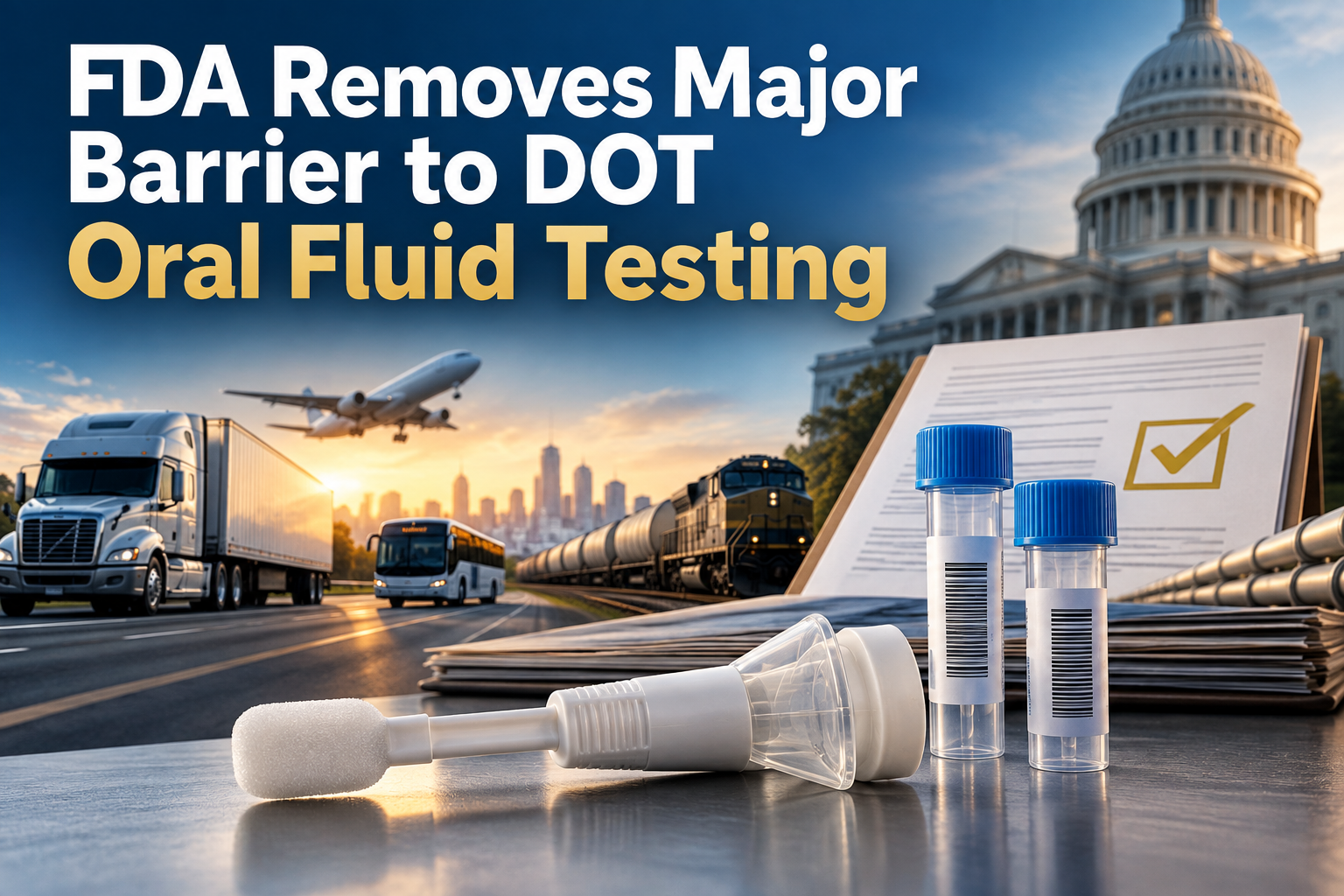
FDA Removes Major Barrier to DOT Oral Fluid Testing
DOT Drug Testing Regulatory Update | October 6, 2026
FDA Removes Major Barrier to DOT Oral Fluid Drug Testing: What Happens Next?
The FDA's final order represents one of the most important steps yet toward making federally regulated oral fluid drug testing operational. But it is important to understand exactly what changed—and what still must happen before DOT employers can begin using oral fluid testing.
By Accredited Training Academy
On October 6, 2026, the U.S. Food and Drug Administration issued a final order expanding exemptions from the 510(k) premarket notification requirement for specified clinical toxicology test systems intended for use in Federal drug testing programs.
For the drug and alcohol testing industry, this is a major development. The 510(k) issue had become a significant obstacle standing between the federal oral fluid rules already established by HHS and DOT and the practical laboratory and manufacturer infrastructure needed to move oral fluid testing toward implementation.
James A. Greer, President of the Accredited Training Academy and Chairman Emeritus of the National Drug and Alcohol Screening Association (NDASA), stated, "This action by the FDA is one of the final steps in the implementation of oral fluid testing for DOT safety sensitive employees and will most likely allow DOT oral fluid testing to begin in the coming months."
What Exactly Did the FDA Change?
The FDA expanded the 510(k) exemptions for certain clinical toxicology test systems used in Federal drug testing programs. According to the final order, a 510(k) will no longer be required for the identified devices, subject to the FDA's general and partial limitations on those exemptions.
The order addresses multiple categories of clinical toxicology test systems and is important because it reduces a regulatory hurdle that affected manufacturers seeking to support federally regulated testing.
This is particularly significant for oral fluid testing because the federal framework has been caught in an unusual position: the regulatory rules allowing oral fluid had been established, but the operational infrastructure necessary to make the program function had not yet fully materialized.
The People and Advocacy Behind the Regulatory Change
Regulatory changes of this magnitude rarely happen because of one meeting or one letter. According to the National Drug and Alcohol Screening Association (NDASA), this effort resulted from sustained industry advocacy, technical work, direct engagement with federal officials, congressional outreach and participation by the broader drug testing community.
NDASA has publicly credited a coalition of industry leaders who helped build and advance the effort:
NDASA Chairman and a central leader in the coalition advocating for removal of the federal testing barrier.
Executive Director of NDASA, who helped coordinate industry advocacy and engagement with federal policymakers.
NDASA Chairman Emeritus, who participated in the coalition's work with HHS and congressional leaders.
A nationally recognized drug testing expert whose scientific and technical expertise helped support the industry's regulatory position.
Government affairs strategist who assisted the coalition's engagement with Congress and the Executive Branch.
NDASA reported that these leaders developed the regulatory argument, engaged directly with leadership at the U.S. Department of Health and Human Services, worked with congressional offices and organized industry stakeholders around the effort.
Congressional Support Added Momentum
The effort also reached Capitol Hill. In April 2026, U.S. Representatives Andy Harris, M.D., Ben Cline, Pete Sessions, Mike Bost, Mike Collins and Claudia Tenney sent a formal letter to HHS Secretary Robert F. Kennedy Jr. urging action on the regulatory barriers affecting oral fluid testing in federally regulated safety-sensitive industries.
That congressional engagement followed advocacy by the coalition and meetings with HHS. The FDA subsequently published its proposal on May 1, 2026, accepted public comments, and then finalized the exemption expansion on October 6, 2026.
April 2026: Congressional leaders formally press HHS regarding the federal regulatory barrier.
May 1, 2026: FDA publishes its proposal to expand the 510(k) exemptions and opens a public comment period.
June 2026: NDASA encourages members and industry stakeholders to submit comments supporting modernization.
October 6, 2026: FDA publishes its final order, removing the 510(k) requirement for the specified systems, subject to applicable limitations.
The result demonstrates the importance of industry participation in the regulatory process. Associations, laboratories, manufacturers, C/TPAs, collectors, employers, scientists and policymakers all have a role in ensuring that federal drug testing policy keeps pace with science, technology and emerging drug threats.
Why This Matters So Much for DOT Oral Fluid Testing
DOT amended 49 CFR Part 40 in 2023 to authorize oral fluid as an alternate specimen for DOT drug testing. The rule created the regulatory framework, including collector qualification requirements and procedures for oral fluid collections.
But publishing a regulation and having an operational testing system are two different things.
For DOT oral fluid testing to function at scale, the industry needs laboratories capable of operating under the HHS Mandatory Guidelines, appropriate collection devices and systems, trained collectors, established laboratory processes, MRO procedures, C/TPA workflows and employer programs that comply with DOT requirements.
The FDA action addresses an important piece of that infrastructure by reducing the regulatory burden associated with specified clinical toxicology test systems used in Federal drug testing programs.
What the FDA Order Does NOT Do
This distinction is critical for employers and service agents.
The October 6 FDA order should not be interpreted as an announcement that every DOT employer may immediately replace urine testing with oral fluid testing. FDA itself stated in the final order that although the exemption expansion may facilitate oral fluid testing in Federal programs, FDA does not oversee those programs and does not determine when oral fluid testing may be used.
DOT-regulated employers, collectors and C/TPAs must continue to follow the current requirements of 49 CFR Part 40 and applicable DOT agency regulations.
The Laboratory Issue Remains Critical
One of the biggest practical issues has been the availability of HHS-certified laboratories for oral fluid testing. HHS certification is not simply a commercial laboratory designation. Applicant laboratories must successfully complete the federal certification process before they can be considered HHS-certified for the applicable specimen type.
Therefore, employers should continue to verify the current HHS-certified laboratory status and DOT requirements rather than assuming that the FDA announcement alone activates oral fluid testing.
Why Oral Fluid Testing Is Important to the DOT Program
Oral fluid offers several operational advantages. The collection is directly observed, which can reduce opportunities for specimen substitution and certain forms of tampering. Collections can also be performed without the privacy and logistical considerations associated with urine collection.
Oral fluid may be particularly valuable when employers need an observed collection methodology or when circumstances make urine collection difficult. Its detection characteristics also differ from urine, which can make oral fluid useful in identifying more recent drug use depending on the drug and testing circumstances.
That does not mean oral fluid simply replaces urine. DOT's framework contemplates oral fluid as an alternate authorized specimen, and employers and service agents will need policies and procedures that account for when each specimen type is appropriate under the regulations.
What This Means for DOT Collectors
The coming transition creates an important opportunity—and responsibility—for professional collectors.
A collector who is qualified to conduct DOT urine collections is not automatically qualified to conduct DOT oral fluid collections. Oral fluid has its own qualification requirements, collection procedures, device considerations, documentation requirements and proficiency demonstrations.
Collectors should understand the differences now so they are prepared when operational implementation becomes possible.
What C/TPAs Should Be Doing Now
C/TPAs should not wait until the first employer calls asking for an oral fluid test. Preparation should begin before implementation.
That means reviewing collection-site capabilities, identifying and training oral fluid collectors, monitoring HHS laboratory certification developments, evaluating collection-device availability, updating client education materials, reviewing standing orders and testing protocols, and preparing staff to explain the differences between urine and oral fluid testing.
The best C/TPAs will also make sure their clients understand that this FDA development is significant without overstating what it legally permits today.
What Employers and DERs Should Do
Designated Employer Representatives and DOT-regulated employers should begin educating themselves on oral fluid procedures and reviewing how the methodology could fit into their drug and alcohol testing programs.
Employers should work closely with qualified C/TPAs, collectors, laboratories and MROs before making operational changes. Policies, collection-site instructions and vendor relationships may all need to be updated as implementation advances.
What Happens Next?
The FDA's final order removes one of the most significant regulatory obstacles affecting federal oral fluid drug testing. Attention now turns even more strongly toward HHS/SAMHSA certification, laboratory readiness, manufacturer participation and the remaining steps necessary for practical DOT implementation.
For the drug testing industry, October 6, 2026 should be viewed as a major milestone—not necessarily the finish line.
The industry has spent years preparing for oral fluid testing. With this barrier removed, manufacturers and laboratories have greater regulatory clarity to make the investments needed to support the federal program.
Frequently Asked Questions
Did the FDA just approve DOT oral fluid drug testing?
Not exactly. DOT had already established oral fluid as an authorized specimen type under 49 CFR Part 40. The FDA's October 2026 action removes a major 510(k) regulatory barrier affecting specified testing systems. It does not, by itself, make DOT oral fluid testing immediately operational.
Can a DOT employer begin oral fluid testing now?
Employers should not begin based solely on the FDA order. They must confirm that all current DOT and HHS requirements necessary for oral fluid testing have been satisfied.
Why was the 510(k) issue such a major barrier?
The requirement created additional regulatory hurdles for systems intended for federal testing programs. Removing the requirement for the specified devices can make it more practical for manufacturers and laboratories to support the federal oral fluid program.
Who helped push for this regulatory change?
NDASA has credited Scott Taillie, Jo McGuire, James Greer, R.H. Barry Sample, Ph.D., and Tim Monahan as leaders in the coalition effort. Congressional engagement included Representatives Andy Harris, Ben Cline, Pete Sessions, Mike Bost, Mike Collins and Claudia Tenney.
Do DOT urine collectors automatically qualify as oral fluid collectors?
No. DOT oral fluid collection has separate qualification and proficiency requirements. Collectors must meet the applicable requirements before performing DOT oral fluid collections.
Should collectors get trained before implementation?
Preparing now can help collectors and collection sites understand the procedures and be ready for implementation. Training should not be represented as permission to conduct a DOT oral fluid test before the remaining federal requirements are satisfied.
Will oral fluid replace urine drug testing?
Not necessarily. DOT's framework permits oral fluid as an alternate specimen. Urine testing remains an important part of the federal testing program, and the appropriate specimen may depend on the circumstances and applicable regulatory requirements.
Prepare for DOT Oral Fluid Testing
Accredited Training Academy provides professional education for drug testing collectors, C/TPAs, DERs and other industry professionals. As federal oral fluid implementation advances, proper training will be essential to conducting compliant collections and supporting DOT-regulated employers.
Explore Drug Testing Training CoursesRegulatory Notice: This article is provided for educational purposes and reflects information available as of October 6, 2026. Federal drug testing requirements can change. Employers and service agents should verify current DOT, HHS/SAMHSA and applicable DOT agency requirements before implementing testing procedures.