ATA & Industry News
FMCSA Clearinghouse Statistics 2026
Home › Blog › FMCSA Clearinghouse Statistics 2026
FMCSA Clearinghouse Statistics 2026: What the Latest Data Shows
By Accredited Training Academy | Published October 8, 2026 | Data as of February 1, 2026
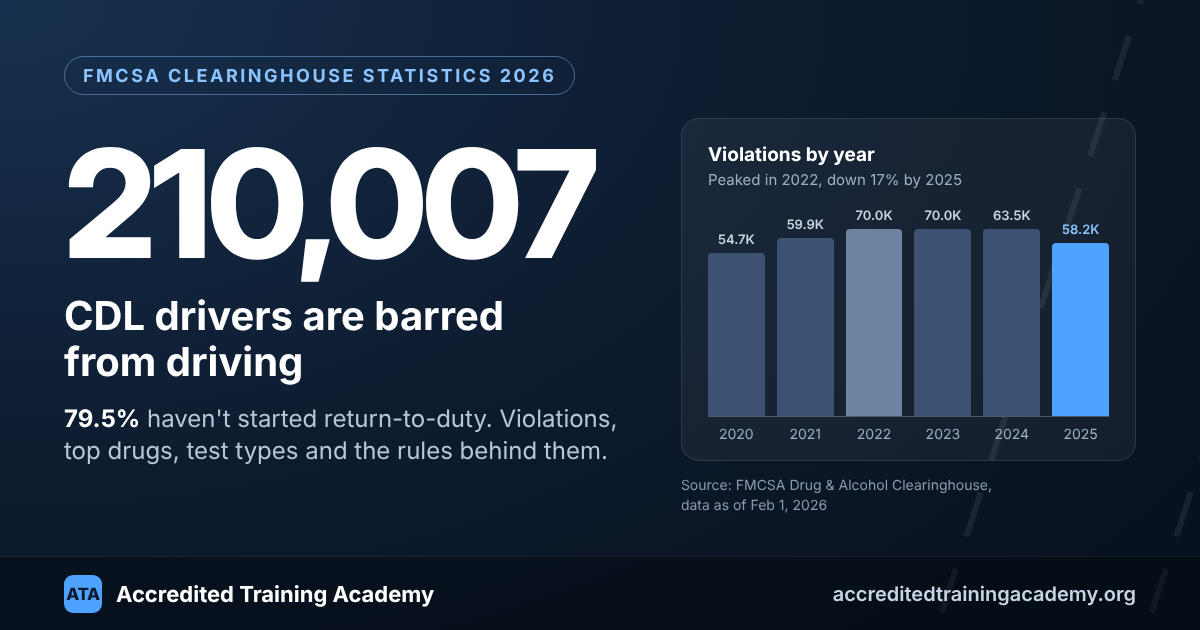
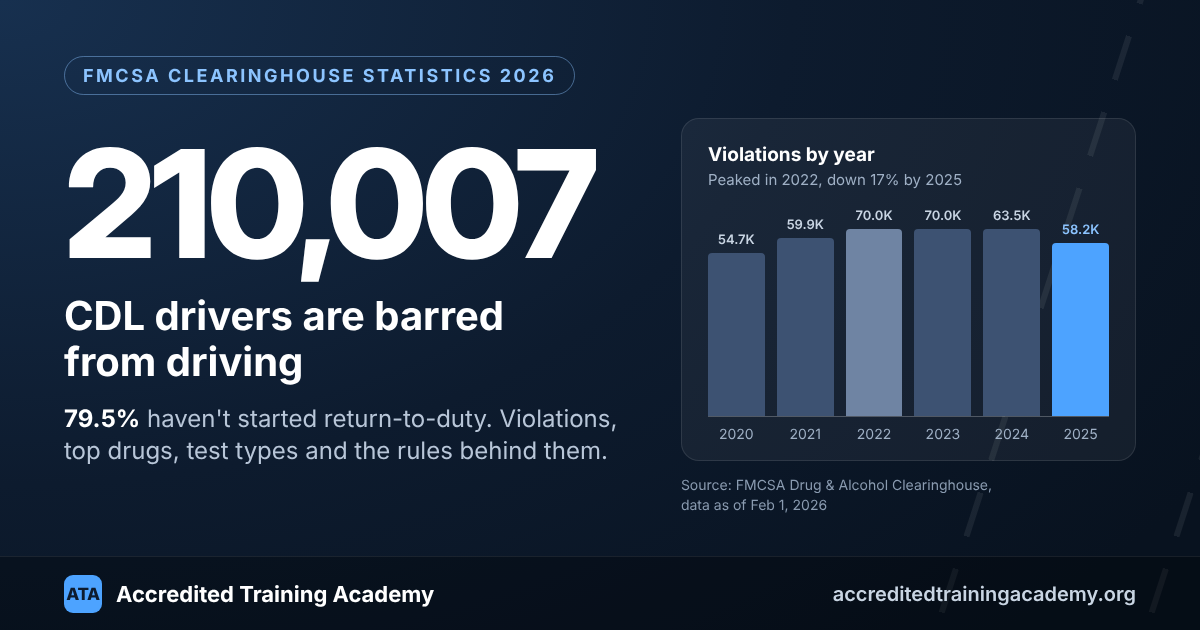
The short answer: As of February 1, 2026, the FMCSA Drug and Alcohol Clearinghouse has recorded 380,217 drug and alcohol violations since it launched in January 2020. Those violations belong to 329,183 CDL and CLP drivers, and 210,007 of them are still barred from driving a commercial vehicle.
Key Clearinghouse Statistics at a Glance
- 210,007 drivers are in prohibited status. Most of them (79.5%) have not started the return-to-duty process.
- Violations are falling. Annual violations peaked at 70,049 in 2022 and dropped to 58,167 in 2025.
- Marijuana dominates. It appeared in 32,951 positive tests in 2025, more than every other substance combined.
- Pre-employment tests account for the most drug violations. They represent approximately 56% of drug test violations since 2020.
- Alcohol violations keep rising. They grew from 1,159 in 2020 to 1,716 in 2025.
- Employers are checking more than ever. A record 3.67 million unique drivers were queried in 2025.
- Prohibited drivers lose their CDL privileges. Clearinghouse II requires state licensing agencies to downgrade commercial driving privileges for drivers in prohibited status.
210,007 Drivers Are Sidelined, and Most Haven't Started Getting Back
Two out of three drivers with a violation on record are still prohibited from operating a commercial motor vehicle. A driver stays prohibited until they complete the return-to-duty (RTD) process and pass an RTD test.
| Status | Drivers |
|---|---|
| Drivers with at least one violation | 329,183 |
| Cleared: passed RTD test | 78,552 |
| Cleared: also finished follow-up testing | 40,624 |
| Still prohibited | 210,007 |
Among the 210,007 prohibited drivers:
- 166,925 (79.5%) have not started the RTD process at all.
- 19,361 (9.2%) have started but are not yet eligible for an RTD test.
- 23,721 (11.3%) are eligible for the RTD test but haven't taken it.
That last group is worth noticing. Nearly 24,000 drivers have completed the SAP steps needed to become eligible for RTD testing but still need a qualifying negative test before returning to safety-sensitive work.
How the Return-to-Duty Process Works
- The driver selects a SAP and sends a request through the Clearinghouse.
- The SAP accepts the designation.
- The SAP completes the initial assessment and recommends education or treatment.
- After the driver completes it, the SAP conducts the required follow-up evaluation and determines eligibility for RTD testing.
- The driver takes a directly observed RTD test with a qualifying negative result.
- The driver completes the follow-up testing plan the SAP set, including at least six tests in the first 12 months of safety-sensitive duty.
Violations Peaked in 2022 and Have Dropped Three Years Running
Clearinghouse Violations by Year
Drug and alcohol violations per year, 2020–2025. The 2025 total was approximately 17% below the 2022 peak.
| Year | Drug | Alcohol | Total |
|---|---|---|---|
| 2020 | 53,582 | 1,159 | 54,741 |
| 2021 | 58,428 | 1,433 | 59,861 |
| 2022 | 68,531 | 1,518 | 70,049 |
| 2023 | 68,391 | 1,610 | 70,001 |
| 2024 | 61,822 | 1,701 | 63,523 |
| 2025 | 56,451 | 1,716 | 58,167 |
| 2026 (Jan) | 3,752 | 123 | 3,875 |
| Total | 370,957 | 9,260 | 380,217 |
Violations hit 70,049 in 2022, the busiest year since the Clearinghouse launched. They fell to 58,167 in 2025, an 8.4% drop from 2024. Of the 380,217 violations recorded through February 1, 2026, 97.6% are drug violations.
What Counts as a Violation?
| Violation Type | Drug | Alcohol |
|---|---|---|
| Positive test or BAC of 0.04 or higher | 309,717 (83.5%) | 5,794 (62.6%) |
| Refusal to test | 55,585 (15.0%) | 1,935 (20.9%) |
| Employer's actual knowledge of use | 5,655 (1.5%) | 1,531 (16.5%) |
Refusals matter. Nearly one in six drug violations is a refusal, which can include leaving a collection before completion, failing to provide a specimen without a valid medical reason, or tampering. A refusal carries the same DOT removal-from-duty and RTD consequences as a positive test.
Marijuana Is Still the Most Common Drug in DOT Testing
Substances Identified in DOT Positive Drug Tests — 2025
One test may identify more than one substance.
| Substance | Identifications |
|---|---|
| Marijuana metabolite | 32,951 |
| Cocaine metabolite | 9,083 |
| Methamphetamine | 4,115 |
| Amphetamine | 3,506 |
| Oxymorphone | 971 |
| Oxycodone | 814 |
| Hydromorphone | 734 |
| Hydrocodone | 686 |
| Morphine | 379 |
| Codeine | 318 |
| Ecstasy (MDMA) | 88 |
| Heroin (6-AM) | 78 |
| PCP | 75 |
| MDA | 44 |
Marijuana has been identified 207,943 times since 2020, more than all other substances combined. Its count is falling, down 5.6% from 2024 to 2025, but not because of any change in the rules. Marijuana remains prohibited for DOT-regulated drivers in every state, including states where it is legal.
Cocaine is a distant second at 9,083 identifications in 2025. Methamphetamine and amphetamine follow, each down roughly 10% year over year.
A few smaller trends stand out from 2024 to 2025:
- Rising: Ecstasy (MDMA, +4.8%), hydromorphone (+2.7%), oxycodone (+1.2%) and codeine (+0.6%).
- Falling fastest: Heroin's marker 6-acetylmorphine (-23.5%) and MDA (-17.0%).
- Dilute specimens: FMCSA has logged 15,624 dilute specimen reports since 2020, 164 of them in January 2026 alone.
Which DOT Tests Identify the Most Violations?
Pre-employment drug tests produce more violations than any other test type. Random testing accounts for the largest share of alcohol violations.
| Test Type | Drug | Share | Alcohol | Share |
|---|---|---|---|---|
| Pre-employment | 203,283 | 55.6% | 375 | 4.9% |
| Random | 118,517 | 32.4% | 4,078 | 52.8% |
| Post-accident | 14,648 | 4.0% | 773 | 10.0% |
| Follow-up | 14,454 | 4.0% | 374 | 4.8% |
| Return-to-duty | 8,436 | 2.3% | 73 | 0.9% |
| Reasonable suspicion | 5,964 | 1.6% | 2,056 | 26.6% |
| Total | 365,302 | 7,729 |
Three things employers should take from this:
- Pre-employment screening works. Drug violations at the hiring stage fell from 39,858 in 2022 to 29,846 in 2025, but they are still more than half of the total.
- Follow-up violations are climbing. They rose every year, from 1,166 in 2020 to 2,984 in 2025. Drivers who already went through return-to-duty are testing positive again.
- Trained supervisors matter. Reasonable suspicion accounts for more than one-quarter of alcohol violations but under 2% of drug violations.
Alcohol violations as a whole rose every year from 2020 (1,159) to 2025 (1,716), even as drug violations fell.
Employers Are Checking the Clearinghouse More Than Ever
Employers queried a record 3,670,089 unique drivers in 2025. Since launch, 6,296,461 different drivers have had their records checked, across approximately 38.7 million queries.
FMCSA requires two kinds of queries. Employers must run a full query before permitting a prospective CDL or CLP driver to perform covered safety-sensitive work, and at least an annual query for each current covered driver.
In 2025, employers ran:
- 3,519,422 limited queries (54%), mostly annual checks on current drivers.
- 2,748,799 pre-employment queries (43%), the highest number on record.
- 196,063 other full queries (3%), including queries conducted after a limited query identified a record.
The rise in pre-employment queries points to continued hiring and driver turnover. Employers must complete the required Clearinghouse inquiry and DOT pre-employment testing before permitting covered safety-sensitive work.
Who Is Registered?
As of February 1, 2026, the Clearinghouse reported active registrations for:
- 10,169,955 drivers
- 598,266 employers
- 19,047 consortium/third-party administrators (C/TPAs)
- 4,656 substance abuse professionals
- 1,326 medical review officers
Employers registered 111,110 new accounts in 2025, the most since 2020.
Clearinghouse Rules Every Driver and Employer Should Know
A Prohibited Status Now Costs Drivers Their CDL Privileges
Since November 18, 2024, Clearinghouse II requires state licensing agencies to remove commercial privileges from drivers in prohibited status. States must also check Clearinghouse status before issuing, renewing, transferring or upgrading a CDL or CLP.
Commercial privileges may be reinstated after the driver satisfies applicable RTD requirements and state licensing procedures.
Violations Stay on Record for at Least Five Years
A violation remains visible to employers for five years from the violation date, or until the driver finishes return-to-duty and follow-up testing, whichever comes later.
Waiting it out does not restore safety-sensitive duty eligibility. A driver who never completes the RTD process remains prohibited.
Limited and Full Clearinghouse Queries
| Requirement | Limited Query | Full Query |
|---|---|---|
| What it shows | Whether a record exists | Detailed violation information |
| Consent | General written consent obtained outside the Clearinghouse | Electronic consent inside the Clearinghouse |
| When required | At least annually for current covered drivers | Pre-employment and when a limited query identifies a record |
| Price listed in source article | $1.25 | $1.25 |
Registering in the Clearinghouse is free. Drivers must register to provide electronic consent for a full query. Employers must maintain the required written limited-query consent records.
Pricing notice: Verify the current Clearinghouse query price with FMCSA before purchasing a query plan.
Annual Queries Run on a Rolling 12-Month Period
Employers must conduct at least one Clearinghouse query for each covered driver during every 12-month period.
Employers may receive notification when new information is added to a driver's record. When a notification requires additional inquiry, employers must follow the applicable full-query consent requirements and safety-sensitive duty restrictions.
Drivers Without an Employer Can Still Begin RTD
A driver without a current employer can complete the SAP assessment, education or treatment, and follow-up evaluation. Arrangements for the RTD test and reporting must comply with applicable FMCSA requirements.
Owner-Operators Have Both Employer and Driver Responsibilities
Owner-operators must meet applicable employer and driver requirements. This includes Clearinghouse queries, enrollment in a compliant random testing program, and designation of a C/TPA for required Clearinghouse reporting responsibilities.
A DUI Citation Doesn't Always Require RTD
FMCSA has issued enforcement guidance addressing certain actual-knowledge violations involving charges that are dismissed or result in findings of not guilty. Employers and drivers should review the current FMCSA guidance before determining whether a violation can be removed or whether RTD remains required.
What This Means for Employers and Drivers
For employers and fleet managers: Pre-employment testing and Clearinghouse queries are important safeguards. Maintain a compliant random testing program, train supervisors on reasonable suspicion, and ensure prohibited drivers do not perform safety-sensitive functions.
For drivers in prohibited status: A violation does not necessarily end a commercial driving career. The RTD process provides a regulated pathway back through SAP evaluation, recommended education or treatment, and a qualifying RTD test.
For owner-operators: You are both the employer and the driver. Your responsibilities include participation in a compliant random testing program, required testing, Clearinghouse queries, and C/TPA reporting arrangements.
Get Trained and Get Tested
Supervisors need reasonable suspicion training to recognize possible impairment, and employers need access to DOT-qualified collection services for required drug and alcohol testing.
Frequently Asked Questions
How many drivers are in prohibited status in the Clearinghouse?
As of February 1, 2026, 210,007 CDL and CLP drivers are in prohibited status. That is approximately 64% of the 329,183 drivers with at least one violation on record.
What is the most common drug found in DOT drug tests?
Marijuana. It was identified 32,951 times in 2025 and 207,943 times since 2020. Cocaine is second, with 9,083 identifications in 2025.
How many Clearinghouse violations were there in 2025?
There were 58,167 drug and alcohol violations in 2025: 56,451 drug violations and 1,716 alcohol violations. That is down 8.4% from 2024 and approximately 17% from the 2022 peak.
Does a refusal count as a violation?
Yes. Refusing a DOT test is a violation with the same applicable removal-from-duty and RTD consequences as a positive result. Refusals account for approximately 15% of recorded drug violations.
How does a driver get out of prohibited status?
The driver must complete the applicable SAP evaluation, recommended education or treatment, follow-up evaluation, and a directly observed RTD test with a qualifying negative result. Follow-up testing remains required after returning to safety-sensitive duty.
How often must employers query the Clearinghouse?
Employers must perform a full pre-employment query and at least an annual query for each current covered driver.
How long does a violation stay in the Clearinghouse?
Five years from the violation date, or until the driver completes RTD and follow-up testing, whichever is later.
Can a driver lose their CDL for being in prohibited status?
Yes. Since November 18, 2024, state licensing agencies must downgrade the commercial driving privileges of drivers in prohibited status under Clearinghouse II.
How much does a Clearinghouse query cost?
The original article lists $1.25 per query. Verify current pricing with FMCSA before purchasing a query plan.
Do drivers have to register in the Clearinghouse?
Drivers must register to provide the electronic consent required for a full query. Registration also allows drivers to view their own records.
Authoritative Sources
- FMCSA Drug and Alcohol Clearinghouse January 2026 Monthly Report
- FMCSA Clearinghouse Frequently Asked Questions
- FMCSA CDL Downgrades
- FMCSA Violations and Return-to-Duty
- FMCSA Queries and Consent Requests
Published October 8, 2026. Statistics are attributed to the January 2026 FMCSA Clearinghouse report, with data as of February 1, 2026.